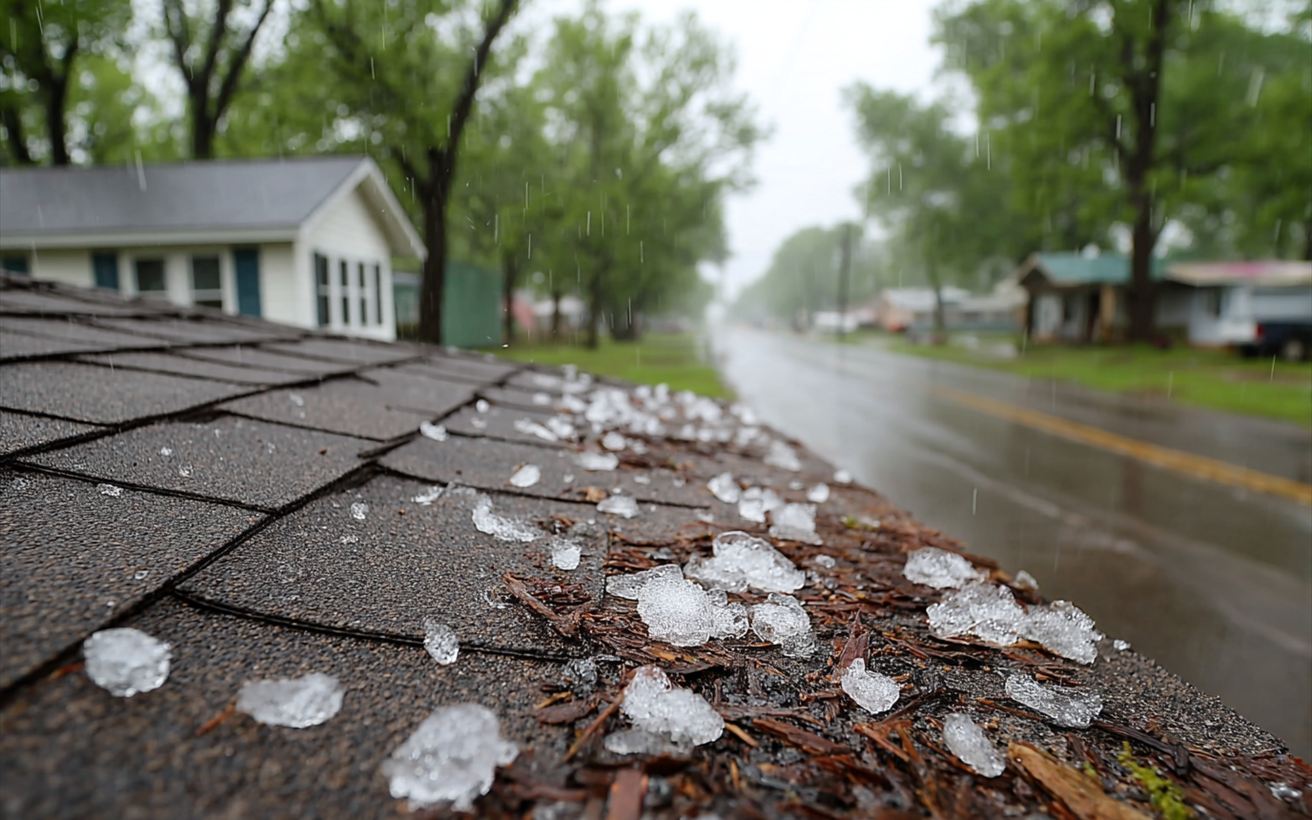
Spring in this part of Texas means thunderstorms, and thunderstorms mean hail and straight-line wind. After a big one, whole neighborhoods around Huntsville and Conroe end up with dented gutters, bruised shingles and the same question: is this worth a claim? This piece walks through what happens between the storm and a decision, without telling you what your policy covers, because only your policy and your insurer can do that.
Right After the Storm
From the ground and inside the house, not from a ladder:
- Photograph every side of the house, the roof as much as you can see it, and any shingles or pieces in the yard.
- Photograph hailstones next to something for scale, like a coin or a tape measure, if they're still on the ground.
- Photograph dents in gutters, downspouts, vent caps, window screens, outdoor units and cars. Insurers often look at "collateral" damage like this.
- Check inside for new stains on ceilings and walls.
- Write down the date and time of the storm.
If a tree or limb has opened the roof, or water is coming in, a temporary cover comes first. Keep the receipt.
What a Roofer Checks
A roofer looks for damage that matters to the roof's life, not just cosmetic marks:
| What they look for | What it means |
|---|---|
| Bruises on shingles | Soft spots where the mat underneath cracked; often invisible from the ground |
| Granule loss | Bare patches that let sun break down the asphalt |
| Cracked or broken shingles | Openings for water |
| Creased or lifted shingles | Wind broke the seal; water can get under |
| Dented vents, flashing and boots | Damage that can leak at penetrations |
| Dents and seam damage on metal | May be cosmetic or may affect how the roof sheds water |
They should photograph what they find and mark it on a simple diagram of the roof.
How Claims Usually Go
Every policy is different, but the usual order is:
- You report the claim to your insurer, with the date of the storm and your photos.
- An adjuster inspects the roof, sometimes with your roofer present.
- The insurer decides what's covered and sends a breakdown of the covered damage.
- Repairs or replacement go ahead, and the insurer pays according to the policy, often minus your deductible and sometimes in stages.
Some policies pay to replace a damaged roof at today's prices; others pay the depreciated value of an older roof. Many Texas policies have separate deductibles for wind and hail, often a percentage of the home's insured value rather than a flat amount. Read your declarations page or ask your agent what applies to you.
Things to Be Careful About
- Don't sign anything that hands your claim or payment to a roofer until you understand it completely.
- Don't let anyone promise that your insurance will pay for a new roof. Only the insurer decides.
- Don't wait too long. Policies set deadlines for reporting damage, and hail damage gets harder to tie to a specific storm as time passes.
- Keep everything: photos, the roofer's report, the adjuster's paperwork, receipts and emails.
The Texas Department of Insurance has consumer guides on homeowners claims and takes complaints about insurers.
Impact-Resistant Shingles After a Claim
If your roof is being replaced after hail, ask about impact-resistant shingles. They cost more, but they resist hail better, and some insurers give a premium discount for them. Ask your agent before choosing.
Questions
Is it worth having a roofer look even if I'm not sure I'll file?
Many owners do, so they understand the damage before talking to their insurer. A roofer can tell you whether the damage is cosmetic or functional.
Can I file a claim months after a hailstorm?
Policies set reporting deadlines, and late claims are harder to prove. Report as soon as you reasonably can.
Will a claim raise my premium?
That depends on your insurer and history. Ask your agent before filing if you're concerned.
Around Huntsville
Hail claims come in waves after spring storms in subdivisions around Conroe and Willis, and older roofs in Downtown and the Square tend to show the damage first. The repair side is on storm and hail damage.
When a Hurricane Reaches Inland: Roof Damage North of Houston
Gulf storms as wind, long rain and falling trees.
Why New Roof Prices Differ So Much in East Texas
Ten things that move the price, no made-up numbers.